What is the Customer Energy Village?
The Customer Energy Village (CEV) is a purpose-built test-site of nine properties in Winlaton, Gateshead. Commissioned and owned by Northern Gas Networks, these properties will allow us to test retrofittable solutions to each property, to help us understand how we might better achieve net-zero.
There are five types of property, each built to original building standards and using materials commonly used at that time, to fully reflect the building fabric and challenges that exist with buildings of each era. The property styles have been designed to be representative of UK housing stock, and include:
- Three 1910s two-bedroom terraces
- Two 1930s three-bedroom semi-detached
- One 1950s two-bedroom bungalow
- Two 1970s two-bedroom flats
- One 1990s four-bedroom detached.
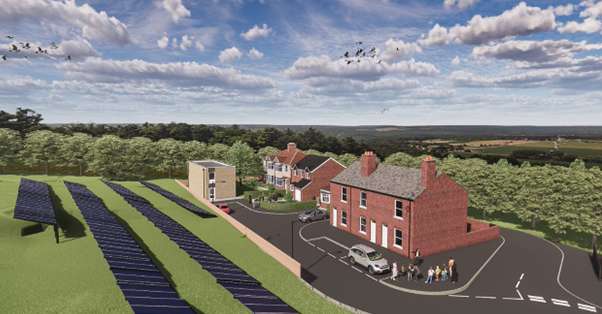
A series of experimental projects will take place at the Customer Energy Village which will help us to better understand how small changes in the home can improve energy and water efficiency, resulting in decreased carbon emissions, and lower customer bills.
Watch our launch video to find out more.
The Customer Energy Village is currently under construction and is due to be completed in 2023. You can see the current progress in the video below.
Why are we doing this?
In order to achieve net-zero targets by 2050, the UK needs to significantly reduce energy and water consumption across its existing housing stock. We have some of the most inefficient housing stock in Europe, and to achieve our target we need to be retrofitting 20,000 properties per week, we are currently only retrofitting 20,000 per year! Being able to test how easy it is to retrofit solutions to properties with different characteristics will help us to find the most effective solutions, and potentially make changes with the way future solutions are designed.
The ongoing energy crisis places significant pressure on household bills. The Energy Price Guarantee has been put in place as a temporary measure to support households, but the price cap is illustrative of a typical household, and so many households, particularly those in inefficient homes, will still be paying much more. Finding solutions that can help people to reduce their energy use at home, while still maintaining levels of comfort and being able to complete their daily tasks, will therefore be a substantial piece of the puzzle to a more secure energy future. Understanding the needs of different households to help make these solutions more accessible is vital to ensuring nobody is left behind in the transition. Small changes at the household level can have a substantial impact on the energy system as a whole.
Customer Energy Village - Energy Efficiency Project
The Energy Efficiency Project is specifically focused on testing retrofittable technologies which change the way we heat our homes and hot water. Through testing, undertaken at the Customer Energy Village site, we hope to understand how the fabric of the building can impact the performance of the technologies, with the aim of identifying the most appropriate technologies for each property type. In addition, we will undertake a series of extensive customer engagement activities, to understand the perceptions of customers to these interventions. We want to understand the barriers or challenges customers may face, depending on their circumstances, and develop potential solutions to overcome these. We hope this engagement will help us to identify possible design changes to the technologies, or to develop additional value-added resources which will improve the effectiveness of the interventions once they are installed in real customers' homes. We also want to understand how customer behaviours could impact the performance of the technologies, and how performance can be improved if delivered in combination with other interventions. Collectively, this set of activities will help us to build a picture of what the decarbonisation of existing housing stock may look like in the future and will allow us to develop policy recommendations to make the journey to net-zero more appealing and accessible to a wider range of consumers.
Customer involvement
As part of this project, we are recruiting 400 customers to take part in a range of engagement activities, including surveys, interviews, focus groups, and potentially, some in-home testing of initiatives. To co-ordinate this, we're working with Northumbrian Water, who have agreed to contact a random sample of their customers with an expression of interest questionnaire. Those who complete the questionnaire will be automatically entered into a prize draw. If you have been contacted to participate in this project, please complete the questionnaire (either online or by post) as soon as possible. If you haven't been contacted, but are interested in taking part please get in touch!
Stakeholder interest
If you are a product manufacturer or supplier, and would like us to test/ showcase your product at the customer energy village, please get in touch with the Energy Innovation Centre (EIC) by emailing enquiries@ukeic.com and including 'NGN Customer Energy Village' in the subject.
Related projects
In addition to the Energy Efficiency project, the Customer Energy Village will play host to a number of other projects too. The first is an Ofwat Innovation Challenge funded project, "Transforming Customers' Lives: Integrated pathways to fair and sustainable water" (Fairwater). This £5.4 million project is led by Northumbrian Water alongside partners including National Energy Action, Northern Gas Networks, Newcastle University and Procter & Gamble, and aims to test and develop more effective and sustainable water and energy solutions for people's homes - including those on low-incomes, the elderly and vulnerable - to find tailored solutions to reducing carbon through energy and water efficiency.
Meet the team
Newcastle University
Prof Savvas Papagiannidis, David Goldman Professor of Innovation and Enterprise, Newcastle University Business SchoolProf Papagiannidis' research interests revolve around electronic business and its various sub-domains and how digital technologies can transform organisations and societies alike. More specifically, his research aims to inform our understanding of how e-business technologies affect the social and business environment, organisational strategies and business models, and how these are implemented in terms of functional innovations (especially in emarketing and ecommerce). His work puts strong emphasis on innovation, new value creation and exploitation of entrepreneurial opportunities, within the context of different industries. Apart from the impact that the Internet and related technologies can have on businesses, he is also very much interested in the impact such technologies can have on individual users.
Diana Gregory Smith, Professor in Marketing, Newcastle University Business School
Prof Gregory Smith's research crosses over several fields: 1) ethical and sustainable marketing and consumption; 2) employee pro-environmental behaviour in the workplace; 2) the psychology of decision making and behaviour change; 3) health and social marketing; 4) technology and consumer behaviour. As an interdisciplinary researcher, Diana's work has been published in a range of subject-specific and interdisciplinary journals such as the Psychology and Marketing, Journal of Marketing Management, Journal of Marketing Communications, Journal of Business Ethics, Computers in Human Behavior, Annals of Tourism Research, Tourism Management, Studies in Higher Education, Frontiers in Psychology, Interface Focus amongst others.
Boguslaw Obara , Professor of Image Informatics, School of Computing, Newcastle University
Prof Obara's research focuses on the design and implementation of complex image analysis and processing, pattern recognition, computer vision and machine learning solutions applied to a wide range of domains. Before joining Newcastle University as Professor; he held research assistant positions at Polish Academy of Sciences and at Computer Vision Laboratory, ETH, Fulbright Fellowship at Vision Research Laboratory, postdoctoral positions at Center for BioImage Informatics, University of California, and at Oxford e-Research Centre, University of Oxford, and assistant, associate and professor positions at Department of Computer Science at Durham University. He was also AstraZeneca Visiting Professor in Image Processing & Artificial Intelligence.
National Energy Action (NEA)
Helen Stockton, Research Manager
Helen has 20 years of applied social research experience spanning the quantitative and qualitative paradigms and holds a BSc (Hons) in Sociology and Social Research; an MSc in Social Research; and MSc in Public Administration covering aspects of social policy development and analysis and public sector management. Helen manages the Research Team at NEA and supports NEA to be the expert voice on fuel poverty through high-quality research and policy analysis. Her areas of research interest include social policy and issues relating to poverty, energy, and social justice. She is enthusiastic about exploring new methodological approaches for researching fuel poverty and the ways that knowledge can be better brokered between academia and those working in policy and practice. Helen also sits on the Advisory Board of the Durham Energy Institute at Durham University.
Michael Hamer, Innovation and Technical Evaluation Manager
Michael is responsible for a team of technical staff, who evaluate the effect of technology as a solution to improving the lives of people living in fuel poverty. This work involves the delivery of socio-technical field trials to understand how innovation can be used to enhance the efficiency of homes, improve resident comfort, reduce costs, and ultimately take householders out of fuel poverty. Michael has extensive project management experience through working in a variety of technical and scientific roles and is supported by a team of four specialist technical officers.